

Let’s start with a paradox.
Most organizations today don’t suffer from a lack of data.
They suffer from too much of it.
More tools.
More dashboards.
More reports.
More numbers.
And yet, the most common question in leadership meetings is still:
“Why didn’t we see this earlier?”
That question reveals something important.
The Myth of “More Data = More Clarity.”
For years, we’ve believed that clarity is a volume problem.
If we collect enough data,
measure enough things,
build enough dashboards—
Clarity will eventually appear.
It doesn’t.
Because clarity doesn’t come from accumulation.
It comes from understanding.
Data Answers Questions You Already Know to Ask
Most data systems are very good at one thing:
Answering predefined questions.
- What were sales last quarter?
- How many users signed up?
- What’s the average response time?
But real clarity doesn’t come from answers like these.
It comes from seeing:
- Why is something changing
- What doesn’t fit the pattern
- Where assumptions quietly broke
Those insights rarely live in neat charts.
They live in:
- Emails explaining exceptions
- Documents describing edge cases
- Notes that never made it into systems
That’s where clarity hides.
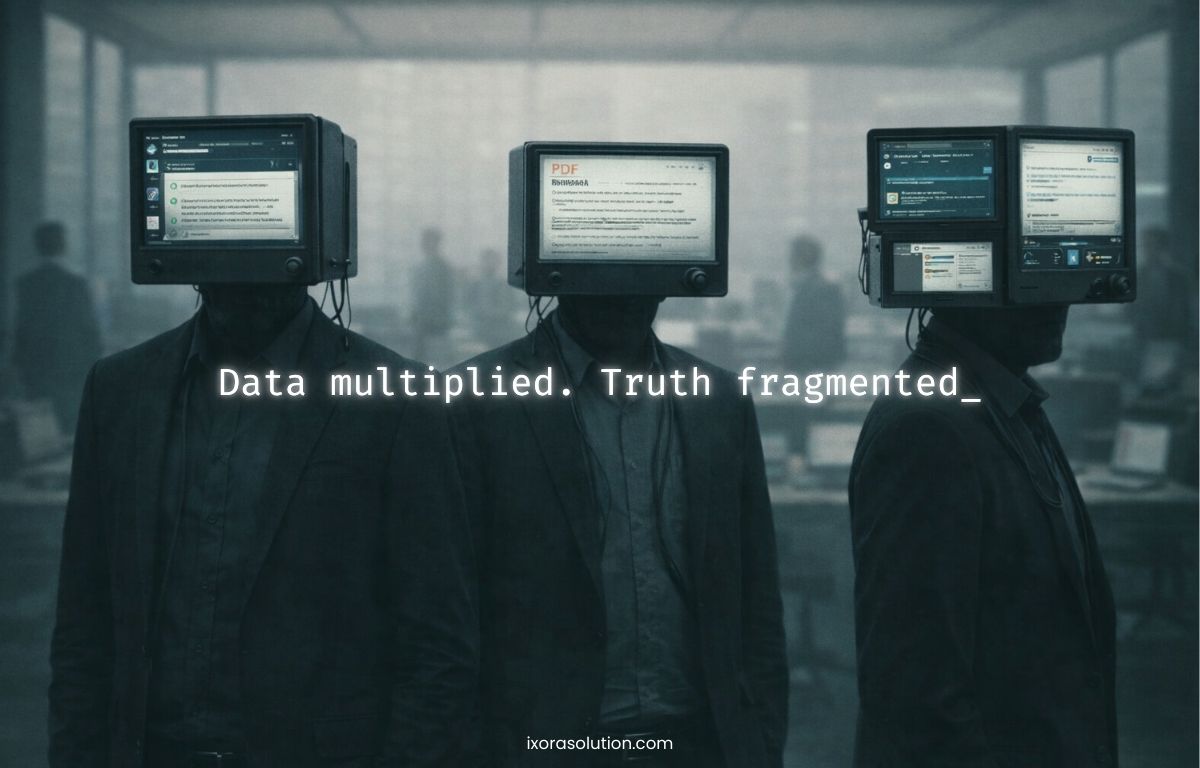
Too Much Data Creates Too Many Truths

Here’s what really happens inside organizations with “plenty of data”:
- Finance has one version of reality
- Operations has another
- Sales has a third
- Leadership sees a summary of all three
Everyone is right.
And no one is aligned.
So decisions slow down—not because people disagree,
but because truth has fragmented.
When there are multiple truths,
confidence disappears.
Why This Feels Normal (Even When It’s Costly)
What makes this dangerous is how normal it feels.
Searching for files.
Reconciling numbers.
Re-explaining context.
Sitting through alignment meetings.
This is labeled as work.
But it’s not progress.
It’s the cost of missing clarity—paid quietly, every day.
Organizations mistake effort for insight.
Reports Don’t Contradict Each Other by Accident
When two reports from the same company show different results, it’s rarely a mistake.
It’s usually because:
- They pulled from different documents
- They interpreted the context differently
- One included an exception buried in a file
- One used a newer version, without knowing it
The data wasn’t wrong.
The meaning wasn’t shared.
Why AI Alone Doesn’t Fix This
AI is often seen as the solution to clarity.
But AI doesn’t magically create understanding.
It accelerates whatever you already have.
If your information is fragmented,
AI will surface fragmentation faster.
If context is missing,
AI will generate confident answers from incomplete signals.
AI scales clarity.
It also scales confusion.
The difference depends on how the information is prepared.
Clarity Is Not a Reporting Problem
This is the shift most organizations miss.
Clarity is not about:
- More dashboards
- Better charts
- Smarter analytics
It’s about design.
How information behaves.
How context travels.
How meaning is preserved as data moves.
When information explains itself,
people stop arguing about numbers.
They start making decisions.
The Real Reason Clarity Is Rare
Clarity is rare because it requires intention.
It requires:
- Connecting information, not just storing it
- Preserving context, not just content
- Designing systems that reduce interpretation, not multiply it
Most organizations collect data first
and hope clarity appears later.
It doesn’t.
A Final Thought

So here’s the simple truth.
Clarity doesn’t disappear because organizations lack data.
It disappears because data multiplies faster than meaning.
When information lives across unstructured data (emails, documents, PDFs, contracts, and conversations),
every team ends up seeing a partial truth.
And when truth fragments, decisions slow down—not from indecision, but from caution.
When information carries context, meaning, and connection,
clarity stops being a meeting outcome.
It becomes the default.
That’s when decisions stop feeling heavy.
They start feeling obvious.
And how you reach that state depends on where your information already lives.
If your organization operates inside the Microsoft ecosystem—
Outlook, Teams, SharePoint, OneDrive—
This clarity can be designed through a custom Copilot agent, built around how your real files behave, how context flows, and how decisions are actually made.
That’s where Ixora comes in.
We don’t start with tools.
We start with the information you already trust—and show how it can explain itself.
If your data lives outside Microsoft—
Google Workspace, Drive, or mixed cloud environments—
The outcome doesn’t change.
Through an agentic approach using platforms like OpenAI Agent Builder or Google Gemini, unstructured information can still be given structure, relationships, and intelligence.
Different ecosystems.
Same principle.
Because clarity was never about having more data.
It was always about designing information so everyone sees the same truth—at the same time.
And when that happens, alignment doesn’t need meetings.
It just happens.

Add a Comment